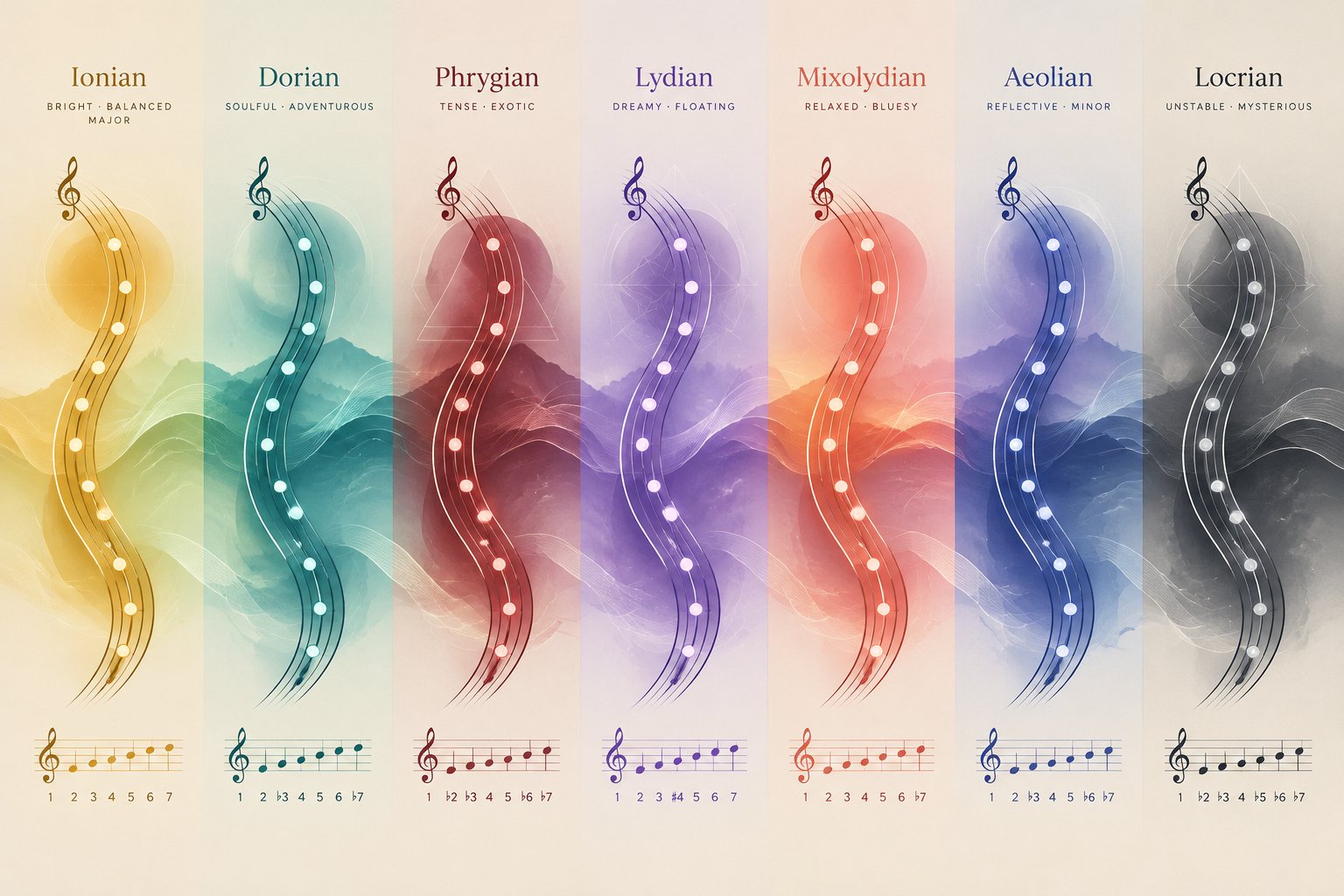
Seven modes · One shared root
From Lydian to Locrian
Start with Lydian: a major scale with a raised 4th. Then move down the list, lowering just one scale degree by one semitone at each step. Every other note stays the same.
All seven scales below start on C. Keeping the root fixed makes it easier to hear how each changed note shifts the character of the scale—from Lydian’s bright, floating sound toward Locrian’s darker, less stable sound.
Degree symbols are relative to the major scale. For example, lowering Lydian’s ♯4 produces Ionian’s natural 4—not ♭4. Each later mode keeps all the alterations already introduced.
-
Start: major scale + ♯4
C Lydian
Bright · floating · expansive
1C 2D 3E ♯4F♯ 5G 6A 7B -
↓ Lower 4: F♯ → F
C Ionian (major)
Clear · familiar · settled
1C 2D 3E 4F 5G 6A 7B -
↓ Lower 7: B → B♭
C Mixolydian
Open · earthy · bluesy
1C 2D 3E 4F 5G 6A ♭7B♭ -
↓ Lower 3: E → E♭
C Dorian
Minor · warm · gently bright
1C 2D ♭3E♭ 4F 5G 6A ♭7B♭ -
↓ Lower 6: A → A♭
C Aeolian (natural minor)
Somber · reflective · dark
1C 2D ♭3E♭ 4F 5G ♭6A♭ ♭7B♭ -
↓ Lower 2: D → D♭
C Phrygian
Dark · tense · close-edged
1C ♭2D♭ ♭3E♭ 4F 5G ♭6A♭ ♭7B♭ -
↓ Lower 5: G → G♭
C Locrian
Unstable · diminished · unresolved
1C ♭2D♭ ♭3E♭ 4F ♭5G♭ ♭6A♭ ♭7B♭