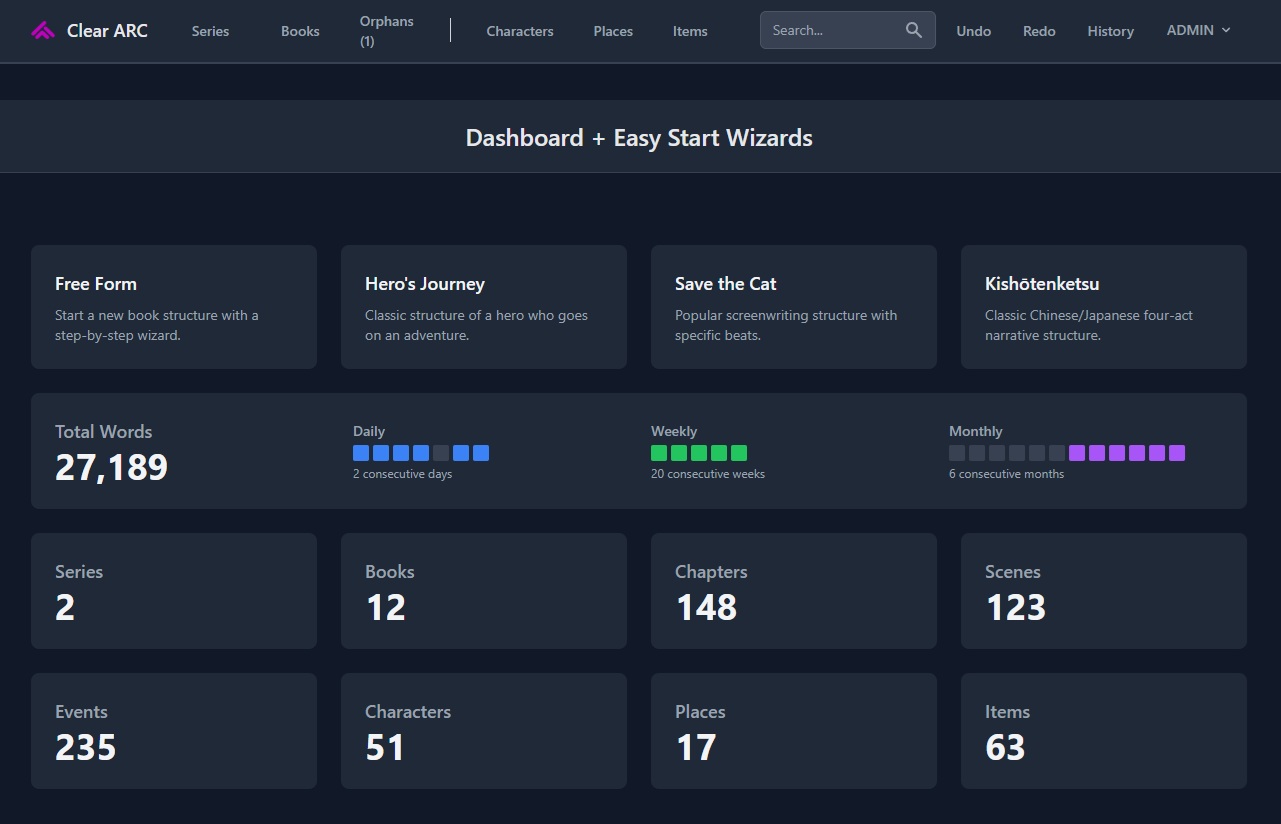
ClearARC
ClearARC is complete. I am cleaning up every area of the code now that I’m satisfied it does the job I wrote it for. It has hundreds of test classes to ensure new additions don’t break anything. Some people code with tests from the start, others, like me, add them later. The reason is that I need to create software first before deciding if it’s actually usable. ClearARC was rewritten from scratch after the first prototype, because I learnt so much about how it should work. If I’d gone down the ‘test driven development’ TDD route, I’d still be in the prototype stage (probably).
Anyway, here’s what made me create ClearARC:
I kept trying to write a novel, but always finished it before the first chapter was done! This is because I could never bring myself to plan out the whole thing first.
So I broke the concept down into its smallest parts, then put it back together in a way that made sense to me.
I knew I needed chapters, so the software needed to let me create them one after another. I knew each chapter needed a name, but had no idea what that name would be yet, so I just named them Chapter 1, Chapter 2 etc.
I could have left it at that of course, but planning really is more than a bunch of chapters!
So I added a hierarchy system: Books > Chapters > Scenes > Events (what screenwriters call ‘beats’).
The idea was to split the chapter into simpler parts starting with scenes. A scene, just like in a movie or theatre, usually happens in one place. And when that’s done, we move on to another place (another scene).
This helped because it created a rule I could use – if I decided the action is going to move to another place, that’s the time to add a new scene. And right now, I may as well call those scenes ‘Scene 1’, ‘Scene 2’ etc. (planning is hard, and coming up with meaningful names just slows me down at the start).
Obviously if all the action in your book happens in the same place from beginning to end, you probably won’t bother with scenes (the point being, it’s your choice, software shouldn’t force things on you).
Once you have your scenes (if you chose to), you can get down to the nitty gritty, and that is events. An event is a single happening. You know the kind of thing: a knock at the door, you open it, and the ghost of your great great gran appears.
Then another event happens – you slam the door and the ghost walks straight through it.
Since you only need to describe the minimum at every step, in no time at all, you have built your entire book from a series of sentences (events).
And with that done, one click, and you have a complete timeline to guide you (or a browsable HTML, PDF, or EPUB file of your whole book if you want to export it).
Which means, for the first time ever (if you’re like me) you’ll get to finish chapter 1, and chapter 2, and who knows, maybe all of it.
So where does all this ARC stuff come in? Simple. You can add character, places, and items wherever you want, and whenever you do, you can add a reason for that action.
The reason could be “Dave’s mood right now is complacency”. In a later event you might add “Dave is starting to get worried, complaceny level is dropping fast”, and later, “Dave is now full-on stressed”. Obviously you describe traits anyway you like, but when you view them sequentially on a timeline along with all the other information, the ARC starts coming to life.
It’s out now and available on subscription. Better still, you get 30 days without paying a penny to try it (credit card required to stop scammers, but no payment will be taken and it’s super simple to cancel anytime).
Pimp my Personality
AI may kill the human species within a decade (according to the latest reports from ex AI alumni coming out of silicon valley) or it may do the opposite. No one knows because ultimately it’s down to whether bad actors use it for their own evil intent and get away with it (presumably, if that happens, they too disappear, I wonder if they’ve thought this through…)
I am working on a new piece of software that clones everything about me. The idea is that I can then get it to become me and do all the work. ROFL.
It is an exercise in just how far AI has come since it first ‘existed’. I have no idea where this will go, but what I do know is that in a matter of 3 days since I started this experiment, I have produced a truly remarkable beast (and no, this is NOT that beast writing, it is me.)
More news in my next update here – which is NOW! I’ve completed this project. It is quite amazing. Enough said. It also led me on to my next project, which I have tentatively called Business Builder…
Business Builder
This came to me from a few recent articles about the brain. First off, I suffered from acute anxiety a year ago. I tried everything pretty much including a number of drugs the doctors prescribed for me. Nothing quite worked although I was on amlodipine for around 6 months until I realised I could control everything myself (having gone through a second batch of CBT provided by the NHS).
But the book that really changed me was Lisa Barrett’s How Emotions Are Made. Latest neuroscience findings prove (certainly to me at least) that we construct our emotions. They are not innate as the world has believed up to now. That means we have the ability to change their effect, that is, how we interpret our feelings. This is a huge deal.
It also gave me an idea for another app. This one asks a bunch of questions about your business, then produces not just a complete marketing plan (even if the business is starting from scratch), but also a constant feedback loop using AI.
It suggests your next move, then waits for you to report feedback on what happened. That feedback informs the next move, and so on. Like the personality app above, this is totally ground breaking. I wish I’d had it decades ago. But then, tech wasn’t ready to deliver it.
This can help so many people. It’s how AI should be used. It has nothing to do with creativity, it is everything to do with productivity (yes, you have to do the work, but knowing what to do is half the battle, and you get the full works when it comes to that).
Watch this space… (or get in touch if you’re interested)
The ICA
There are organisations for pretty much every industry in the world. This one’s dedicated to teaching copywriters how to write more persuasively in an ethical way and make more money doing it.
Join the International Copywriters Association and you’ll get membership of ProCopyClub (my premier copywriter training program) and a whole bunch of AI tools included.
If you have any questions about the ICA, please feel free to use our support portal. You can also book one-on-one time direct with me.
Quentin Pain
PS. This page was inspired by Derek Sivers’ Now Page Movement